I rarely comment on political issues within this blog, now I do. Overall in Europe politians seem to be jumping the bandwagon as to loosing privacy rights and surveillance laws.
The scapegoat here is "Islamic Terror", especially in Germany it is being blamed for pretty much everything. I call Bullshit.
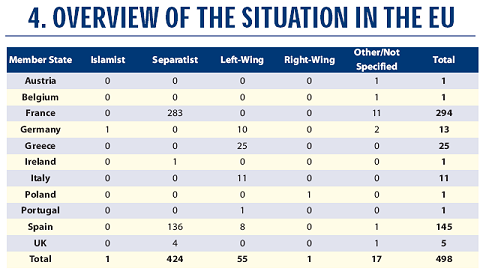
I repeat: "Islamic Terror is the number one threat to Europe" is the chanson of lots of politicians, now check this :
My question is this, how comes a politician can make such claims without being held accountable, when there is clear evidence that he is simply pushing an agenda and doesn't care about reality ? Not too mention these other "Terrorist" groups always existed, always were there. One thing is clear to me, if we don't get off our lame asses and start to do something we soon will be no better than the US.
BTCrack 0.9a is going ahead nice, optimisations have been done and the final release will be on the Nruns website as promised very soon™ :)
BTCrack 0.9a now spawns 8 threads in order to crack the keys, and this implies that dual-core or quad-core processors are working out very nicely :) A few assembler optimisations are still ahead and the final release should be ready for 23c3.
The general assumption that the attack is theroreticaly possible and that Pins of 6 digits represent a good protection is now pratcticaly refuted.
Here are my current stats on a Dual-Core P4 2Ghz (48000 pins per second)
It has been quite some time since I updated this blog, I will try to update the blog in the next weeks, with a few details what I was up to during the last months.
Let's start with the more important stuff, I got into AV Research again =) The output of which will hit the public in the next months, be warned there will be a flood of advisories :D
Together with Sergio Alvarez I gave a talk @ Hack.lu 2007. This year we explained what the heck is up with Anti-Virus software. We revisited the way AV solutions are implemented in current Company networks and AV Engines themselves. Defense in Depth is being misinterpreted and incorrectly implemented with disatrous effects. Customers (end-users of AV Software) believe they do DiD when in reality they do not, this is an important fact to keep in mind.
Rough Break-down of the Talk :
DiD as implemented for Anti Virus Software is broken, companies put one AV engine after the other believing it to be DiD. The worst security incident in such an architecture is being incorrectly defined as "A virus passes the gateway unrecognized" , in reality the worst possible failure is that the underlying Operation System is compromised through the AV Engine, you have to mitigate this.
AV Software is broken behond recognition, they parse enormous amounts of Data in unmanaged programming languanges and such are naturaly prone to errors. This was clear from the start, but the shear amount of bugs is someting else.The reality shows they all are.
AV Software runs directly on critical (with high privileged rights) infrastructure, AV Software runs everywhere
E-mail changes what is at stake: What happens if I sent an exploit targeting AV software as an attachment in an E-mail ? (You can automatically compromise Corporate Mail Servers/Clients/Gateways, from the outside as your email travels through your firewalls untouched. You can view the presentation here, might be interesting to you, I don't think everybody is aware of the impact some findings may have: The Death of AV-Defense in Depth?
A friend and colleague of mine, namely Alexios Fakos has published a Book under the title of Sichere Web Anwendungen, unfortunately it is german only. If you'd like to know how to code hardened Applications I heartly recommend this Book.
Kevin Finistere and myself gave a Bluetooth Presentation at the 23C3 congress in Berlin. We released a bit of 0day and a bit of protocol bugs and tidbits. See for yourself :) Thanks to everyone who made this possible, and to the CCC for organising the event. I couldn't really participate as a spectator, but I got to see the behind-the-scenes work up close, and I was impressed. The organisation was solid, and the people were friendly and helpful throughout.
Main message: there are now underlying protocol security issues, not just implementation ones.
Non-discoverable mode no longer offers any real protection. To attack a device, you first need to know it's there. Previously, if a device was non-discoverable, the only option was to brute-force its address (bd_addr) — which is unreliable and takes a very long time.
During this talk I released a method to passivelydiscover 90% of the address and brute-force only the remaining 8 bits. This is reliable and fast.
The only real protection Bluetooth had against unwanted connections to your device is gone.
Also the paradigm shift from toys to workstations is also considerable:
We can eavedrop on your Laptops Microphone, we can compromise it and take control over it.
The random number generators and the encryption affected by them is weak.
New Re-pairing attack, making the pairing attack INTERESTING.
Your drivers lack control, no update function and are flawed beyhond comprehension
Live demo on how to take over a PC and get a remote shell over Bluetooth
Demo of Interactive Remote Code Execution by chaining three vulnerabilities. OBEX FTP Transveral -> Persistance: Input Manager Autostart -> 0Day Privilege Escalation
Key points from the Presentation :
Pin and Link key recovery is practicaly possible (code release and live demo)
If you use Bluetooth beyboards or mice, your PC has a HID server, these may be attached to inject commands (!) as if you were typing on the keyboard
The random numbers used for encryption and so forth may be very weak for your device
The Pin is not that usefull the Link key is !
Swap over to Bluetooth 2.1 (as soon as possible) and use "Secure Simply Pairing"
Regard the quality of the encryption Bluetooth offers (E0) as a PRIVACY feature NOT a security feature. (Compare it to WEP)
New re-pairing attack : Connect to the master pretending to be from the piconet, use a fake linkkey, master will think (oops lost the pairing) and will re-initiate the pairing given an attacker the choice to capture the exchange and crack it.
Don't trust encryption taking place, sometimes the devices negotiate Security Mode 2, and you don't know your data is actually transferred in clear text (after being authenticated) and you can't actually check as you don't have a Bluetooth Sniffer.
The Bluetooth PIN is actually a Bluetooth Passkey, it supports characters not only digits (this has security implications)
Things to do once you have the link key:
Passively decrypt the traffic
Connect to the slaves pretending to be the master and have full access (no pin required)
Connect to the master pretending to be one of the slaves have full access (no pin required)
Plant the link key on a BT capable machine and have a remote encrypted stealth channel to that machine
Update your Drivers !
Widcomm, Toshiba, Bluesoil, ALL vulnerable
Don't rely on Windows update for that, your BT stack may be from a third party vendor (very likely)
Listening on the Microphone and recording is also possible on PCs (not only cars)
General Recommendations :
Delete your existing pairings as soon as you don't need them
Pair in "secure places" SIG recommendation
As soon as your device asks for a PIN again, don't enter it you might be snooped on (see previously mentioned pairing attack)
Don't trust Bluetooth 1.0 - 1.2 (can't tell for 2.0-2.1 yet)
Companies using Bluetooth for Industrial purposes :
Regenerate a new key every 5 minutes, use 16 chars.
Vendors :
Implement the GUI to use the possibility for bluetooth to use characters (UTF8) NOT ONLY DIGITS.
Please be more transparent towards your device driver version numbers and propose an easy way to update.
Disclaimer: The views and opinions expressed on this blog are my personal views and are not intended to reflect the views of my employer or any other entity.
Weekly Update 514: This Week in Data Breaches
-
The Origin Energy breach down here in Aus is all over the news this week,
and as with many breaches, it's multi-faceted. You've got them leading with
"do...
LG to Ban Residential Proxies from Smart TV Apps
-
The home appliance giant LG Electronics USA said this week it plans to
suspend any apps built for its smart TVs that turn one's television into an
always-o...
GAME: Genetic Algorithm for Malware Evasion
-
This post summarizes the work we presented at the 15th Conference of PhD
Students in Computer Science (CSCS), 2026 in Szeged. My name is Jószef
Sándor, I’m...
Overview of Content Published in June
-
Here is an overview of content I published in June: Blog posts: Update:
base64dump.py Version 0.0.30 SANS ISC Diary entries: Microsoft’s Coreutils
for Wind...
What a lovely sunset
-
Oh, hi. Long time no blog, eh?
Well, it is time to sunset this blog, I will be deleting it in the next few
weeks.
So long, and thanks for all the fis...
The Future of the FTC: Part II
-
A previous blog post discussed FTC Chairwoman Slaughter’s first priority as
the newly designated chairwoman – the COVID-19 pandemic. The FTC’s second
prior...
Minecraft Mod, Follow up, and Java Reflection
-
After yesterday's post, I received a ton of interesting and creative
responses regarding how to get around the mod's restrictions which is what
I love abou...
Youtube channel
-
I've continued to make updates to the python version of satori and have put
a lot of time in the past few weeks to updating fingerprints and fixing
some mi...
In Which You Get a Chance to Save Democracy
-
Let’s start with the end: you can do something to change the broken
political landscape in the United States, but you have to act quickly.
Here’s a link to...
Ma contribution au mois de la cybersécurité
-
Dans le cadre du mois de la sécurité, l'ANSSI met en avant son MOOC : la
SecNumAcadémie. Il m'a semblé opportun de vous résumer les 2h48 que j'ai
passées ...
Introducing Qualys Project Zero?
-
Google's Project Zero team was announced in July 2014. Since then, it has
become very well known for publishing offensive security research of
exceptional ...
VulnHub Stapler 1 Solution
-
Well, after long time, I'm back to blogging ..!!
This post is about the solution for the Stapler VM from VulnHub. The VM
gets the following IP:
Stapler VM...
McAfee SiteList.xml password decryption
-
Recently, a very good friend of mine (@Sn0rkY) pointed me out the story of
a pentester who recovered the encrypted passwords from a McAfee
SiteList.xml fil...
La géolocalisation du salarié par l’employeur
-
Avec l’avènement des nouvelles technologies et leur perfectionnement, de
plus en plus d’employeurs décident de recourir à la géolocalisation de
leurs véh...
Learning SDR
-
I recently launched Software Defined Radio with HackRF, an instructional
video series that I hope will make it easier than ever for people to learn
the bas...
USENIX Security Symposium Slides
-
We're very happy to present the paper
Revisiting SSL/TLS Implementations - New Bleichenbacher Side Channels and
Attacks
by Christopher Meyer, Juraj Somo...
New Insights into Email Spam Operations
-
Our group has been studying spamming botnets for a while, and our efforts
in developing mitigation techniques and taking down botnets have
contributed in d...
RSA Announces End of RSA Security Conference
-
Aims to bring clarity to cloudy marketing messages through exhibit hall
chotskies Bedford, MA., – April 1, 2014 – RSA, the security division of
EMC, today ...
Samsung Galaxy S5 could be cheaper than Galaxy S4
-
Good news for would-be Samsung Galaxy S5 customers - the main smartphone
may end up being more economical as opposed to Galaxy S4 was when it
established. ...
Why I _am_ Speaking At RSA 2014
-
There’s been quite a bit of drama with regards to whether or not to boycott
the RSA conference over a deal that the RSA security vendor had made with
the N...
Router backdoor reloaded...
-
S i vous avez aimé l'histoire de la backdoor D-Link, vous allez A-DO-RER
celle-ci. C'est encore sur /dev/ttyS0 que ça se passe, où on apprend que
les route...
One year after, end of Magnificent 7 project !
-
It has been a year already since the start of the Magnificient 7 program !
So what happened during this year ? We added some features to enhance your
analy...
Mobile Device Forensics - Course Update
-
It's been a few weeks since the last update, but things have been busy. The
Fall 2012 term is now in Week 5 (wow, the semester is flying by). We've
covered...
NWScript JIT engine: Wrap-up (for now)
-
Yesterday, I provided a brief performance overview of the MSIL JIT backend
versus my implementation of an interpretive VM for various workloads.
Today, I’l...





.png)


